Black (holes) boxes all the way down

Author: Zsuzsanna Varga Szegedi

  • Black (holes) boxes all the way down

    Black (holes) boxes all the way down

    by Lea Sande, 19.07.2026

    When labeling something a black box, we are generally conceptualising it as an enclosed system or process that receives clear inputs and generates intelligible outputs, but its inner workings remain unexplainable or unobservable.1 Although the concept emerged from cybernetics and engineering, it can be applied equally to technological, biological, social, and ecological systems. In our daily life, we are constantly dependent on black boxes of different scales. We don’t need to have insight into the logistics of the entire rail network in order to get to work, nor do we need to understand the technical architecture of a kitchen blender to prepare a meal. Based on our understanding, most systems are at least partially black boxed.

    Alexander R. Galloway2 distinguishes between two types of black boxes; the black box as a “cypher” that needs to be decoded, its inner workings revealed by taking off one of the sides and observing its mechanics, and the black box as a “function”, a system that grants just enough opacity to be usable, but never reveals its true structure. He transforms Marx’s famous quote from “rational kernel inside a mystical shell” into “rational shell and the mystical kernel” which shows a qualitative break in our understanding and use of black boxes. If the capitalist market operated as a black box through the intertwined mechanisms of exploitation, appropriation of surplus value, alienation and ideology, once we see through these systems we should be able to demystify the black box, claim our class consciousness and break free. Platform capitalism works through interfaces, abstractions and relays, a system so highly composite that it affords users different levels of transparency based on their nationality, race, gender, profession and social mobility, with the position of the user becoming more and more crucial. The economic system itself is an increasingly complexifying black box, supported by an enormous amount of other auxiliary black boxes that keep it running.

    Not all black boxes need to be dismantled. In fact, our daily life arguably benefits from not seeing the world as a combination of materials and components. Abstraction and modeling let us use the computer without always keeping track of what the processor is currently calculating or how the drivers are interacting, but lets us focus on the emails we need to type. Even human interactions are, to some extent, black boxes that we can only navigate by a computationally very intense combination of reading facial expressions, gestures, social cues and language tokens. This line of thinking resonates with Blaise Agüera y Arcas’s definition of intelligence as the ongoing modeling of other selves, though we invoke it here less as a definitive account of cognition than as a useful way of conceptualizing how opacity and inference structure social interaction.3

    Nevertheless, black boxes often represent the limits of scientific reach and perception, two of the most prominent in recent years being black holes and machine learning, as they both challenge the normative assumptions and understanding of fundamental physics,4 computation and language theories.5 Some of the most prominent advances and breaks in research have come exactly out of probing these black boxes, examining their edge cases and studying the ways they refract or break our current knowledge systems.

    One of the most difficult forms of opacity emerges not from secrecy, but from incommensurability: situations in which different systems of knowledge can no longer be fully translated into one another. In the case of contemporary computational systems, this occurs when the scale, abstraction, or operational logic of a system exceeds the conceptual frameworks available for interpreting it. Based on Bruno Latour’s6 reflections, Beatrice Fazi7 argues that even science itself is a black box in the way it operates, as “[s]cience, for Latour, can become a black box when its inner workings are no longer open for scrutiny or debate, when consensus has been reached about certain results, when the success of a theory or a method obscures how scientific and technical work operates, and when a hypothesis is settled as a matter of fact. So, paradoxically, ‘the more science and technology succeed, the more opaque and obscure they become’”.8

    Furthermore, in regards to the Jenna Burrell proposes a typology,9 of three kinds of black boxes: opacity as intentional corporate or state secrecy that generates a black box by the obfuscation of knowledge about a system from a third party, opacity as technical illiteracy that creates a black box due to the lack of understanding as a personal circumstance, and opacity as the way algorithms operate at the scale of application. This last, we can translate to: opacity that stems from the fundamental mismatch of knowledge systems. The most complex and difficult to breach, opacity as epistemic mismatch materialises, for instance, in machine learning research as a rudimentary conflict between our own and the computational understanding of abstraction – an inability of two systems of knowing the world to coexist or be integrated with each other.

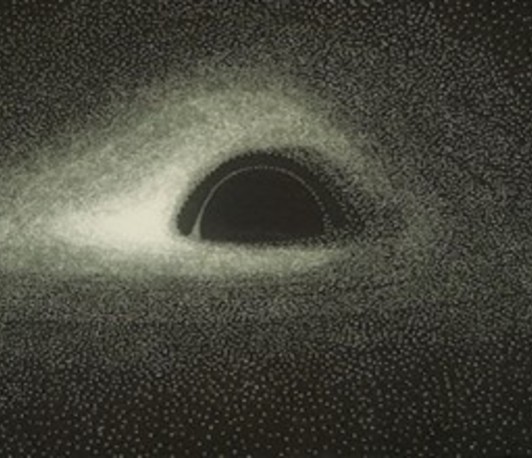
    Because the position of the observer, both in black boxes and black holes, is key, the only way to meaningfully study them and try to move past the problem of incommensurability is to try to analyse them from many different viewpoints10. Just as the Event horizon Telescope Collaboration11 combined an unimaginable amount of data from different perspectives to generate an image, scientific progress in studying black holes is most productive when taking a similar approach.

    What is most interesting is that, in the case of black holes, black boxing appears to loop back on itself, as it brings into relation theoretical frameworks that were previously in tension – like quantum gravity and conformal field theory – through constructs such as the correspondence between conformal field theories and Anti-de Sitter spaces. These theories do not fully reconcile, but are made to coexist within a shared formal structure. In this sense, black holes break scientific perception and bend the boundaries between incommensurable paradigms, forcing them into relation in our attempts to understand these complex phenomena.

    Black holes should thus be studied as black boxes, because they both limit transparency and reflect the frameworks through which we try to conceptualise them while also reorganising the conditions of explanation, forcing incompatible theories into uneasy but productive relations. A black hole and its event horizon is a site where knowledge bends, multiplies, and becomes probabilistic. As Iris Long writes, “we should catch sight of […] the black box as an unformed spacetime, a field of proto-probabilities […].”12 Therefore, black holes might just represent the most compelling and complex black boxes of all.


    1. Galloway, A. R. (2010). Black box, black bloc (Lecture delivered at the New School, New York City, April 12, 2010), Fazi, M. B. (2021). Beyond human: Deep learning, explainability and representation. Theory, Culture & Society, 38(7–8), 55–77. https://doi.org/10.1177/0263276420966386, Latour, B. (1987). Science in action: How to follow scientists and engineers through society. Harvard University Press & Ashby, W. R. (1956). An introduction to cybernetics. Chapman & Hall, 68-93. ↩︎
    2. Galloway, A. R. (2010). Black box, black bloc (Lecture delivered at the New School, New York City, April 12, 2010) ↩︎
    3. Aguera y Arcas, B. (2025). What is intelligence? Noēma Magazine. https://www.noemamag.com/what-is-intelligence/ ↩︎
    4. Barack, L., Cardoso, V., Nissanke, S., Sotiriou, T. P., Askar, A., Belczynski, K., Bertone, G., Bon, E., Blas, D., Brito, R., Bulik, T., Burrage, C., Byrnes, C. T., Caprini, C., Chernyakova, M., Chruściel, P., Colpi, M., Ferrari, V., Gaggero, D., Gair, J., et al. (2019). Black holes, gravitational waves and fundamental physics: A roadmap. arXiv. https://doi.org/10.48550/arXiv.1806.05195 ↩︎
    5. Beguš, G., Dąbkowski, M., & Rhodes, R. (2023). Large linguistic models: Investigating LLMs’ metalinguistic abilities. arXiv. https://arxiv.org/abs/2305.00948 ↩︎
    6. Latour, B. (1987). Science in action: How to follow scientists and engineers through society. Harvard University Press. ↩︎
    7. Fazi, M. B. (2021). Beyond human: Deep learning, explainability and representation. Theory, Culture & Society, 38(7–8), 55–77. https://doi.org/10.1177/0263276420966386 ↩︎
    8. Ibid.: 60 ↩︎
    9. Burrell, J. (2016). How the machine ‘thinks’: Understanding opacity in machine learning algorithms. Big Data & Society, 3(1), 1–12. https://doi.org/10.1177/2053951715622512 ↩︎
    10. Polonyi, E., & Grozdanov, S. (2025). When observation becomes entanglement: Physics, photography, and data [Conference session]. The Sun’s Glow, the Black Hole’s Shade: Where Observation Begins & Ends, Bibliotheca Hertziana – Max Planck Institute for Art History, Rome, Italy and online. https://www.biblhertz.it/events/43555/2643800 ↩︎
    11. https://eventhorizontelescope.org/ ↩︎
    12. Long, I. (2025). The moon’s reflection on the water and the flower’s reflection in a mirror. In B. Bratton, A. Greenspan, A. Ireland, & B. Konior (Eds.), Machine decision is not final: China and the history and future of artificial intelligence pp. 224. Urbanomic. ↩︎


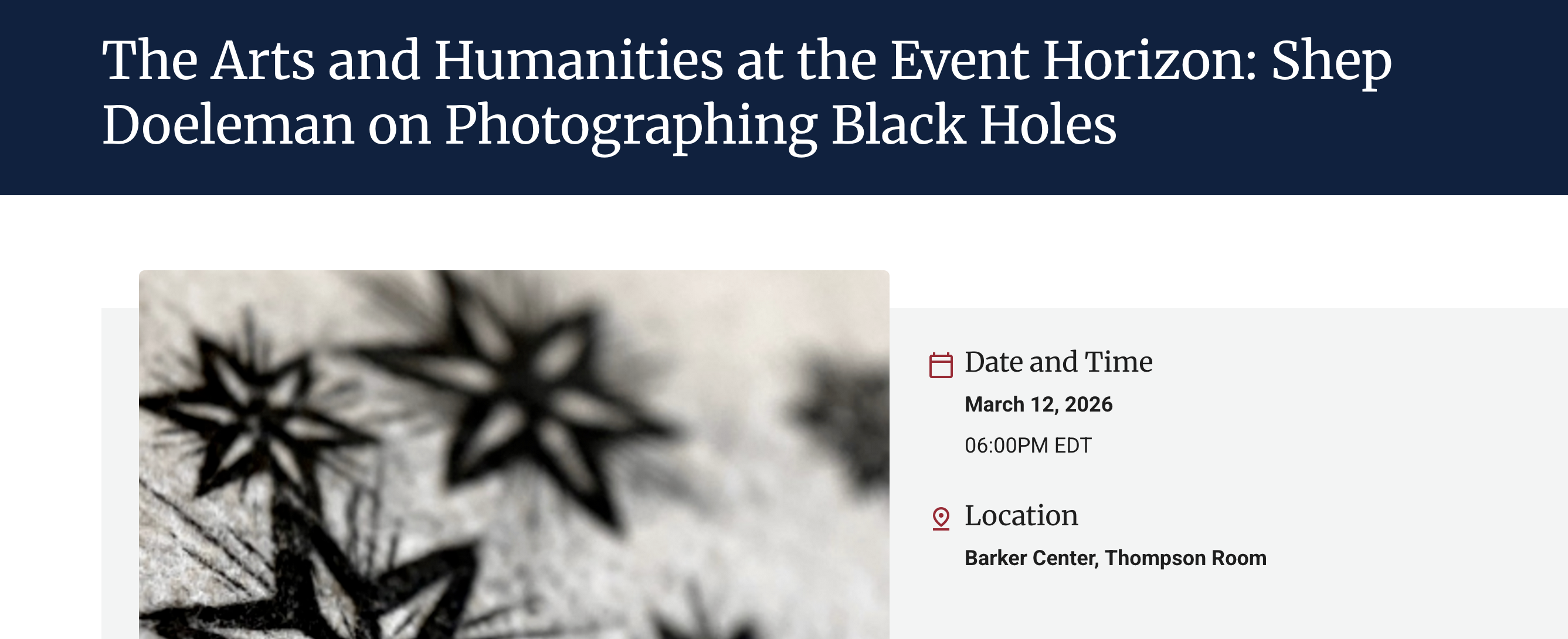
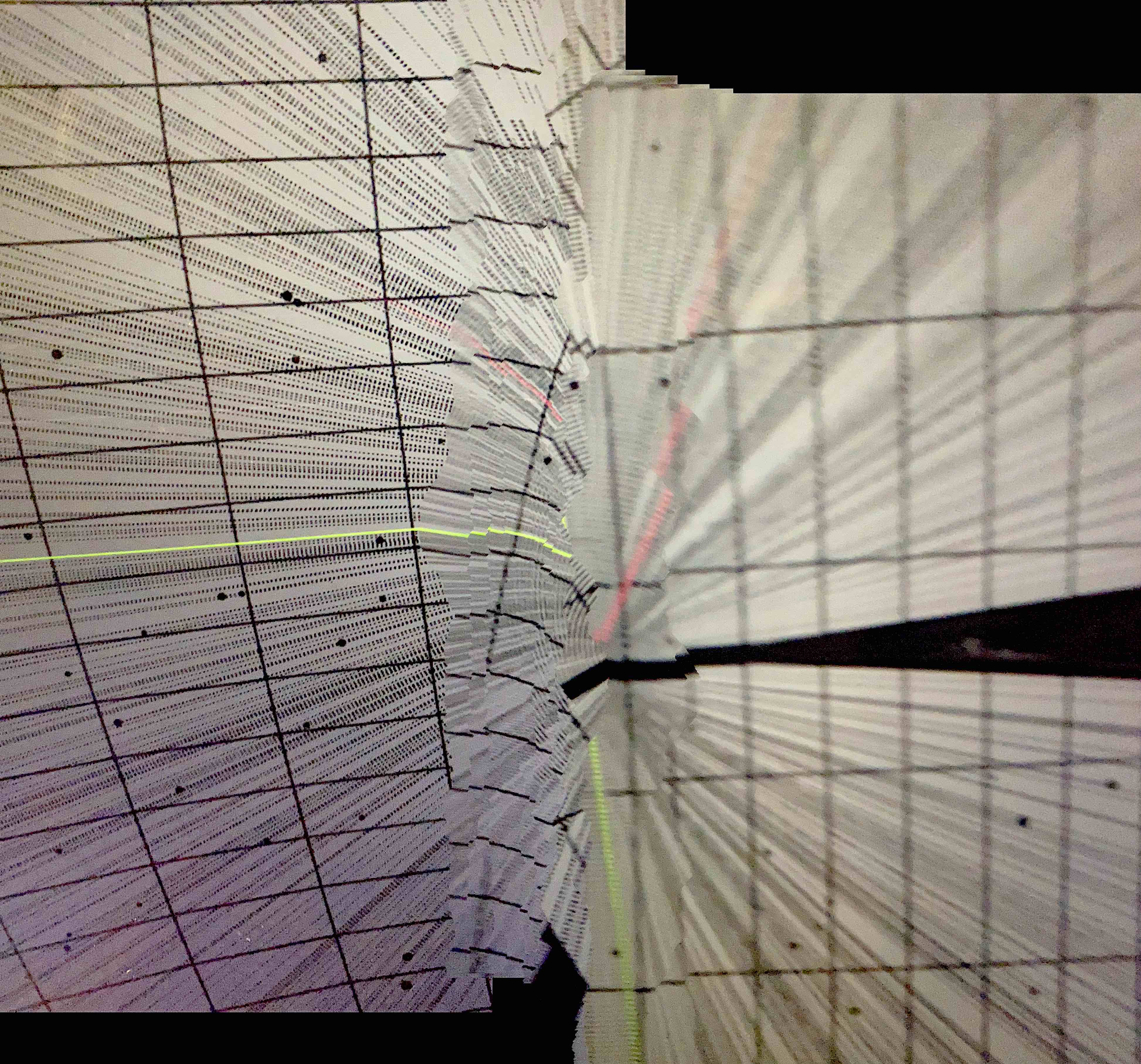
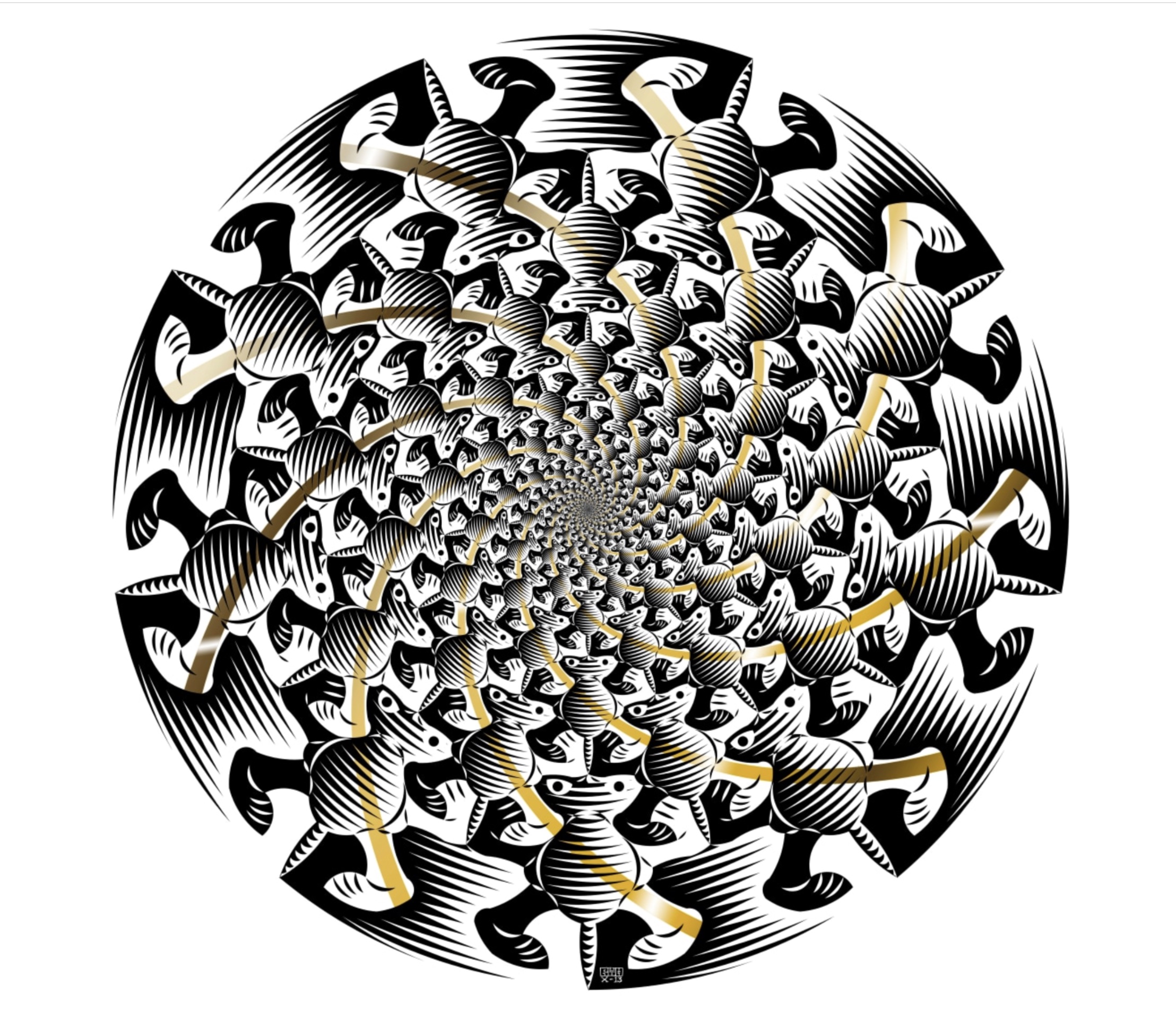
    Top image: Richard Hassell. Turtles All the Way Down I, Edition of 8, 2015. Archival print with gold leaf. The author gratefully acknowledges Richard Hassell for granting permission to reproduce this work
  • Image Making as Knowledge Production: Earth, Heavens, and Body

    Image Making as Knowledge Production: Earth, Heavens, and Body

    Shep Doeleman on Photographing Black Holes

    CELESTIAL SPHERES

    Date: March 12, 2026 Time: 06:00PM EDT

    Location: Barker Center, Thompson Room

    How does the act of drawing, engraving, painting, or photographing play a role in thinking and understanding? What is the role of image-making in knowledge production? Across three themes (Earth, Heavens, and Body) we will discuss these questions in case studies from the late Middle Ages to the contemporary.Each day will start with a presentation by image-makers, to reflect on current visual practices of the context of teaching and learning, and research. The main part of the day will contain historical case studies. And each day will be closed by natural scientists reflecting on the role of image-making as doing science.
    This interdisciplinary dialogue between current-day practices and the study of historical practices in art and science have been a driving force behind the research of the Research Group Visualizing Science in Media Revolutions. With its broad temporal and thematic scope, the focus on image-making practices as both a highly skilled and highly creative process has become central to understanding how people gained and communicated knowledge.

    Please follow the event also online through our VIMEO CHANNEL:
    25.06.26 https://vimeo.com/event/590949426.06.26 https://vimeo.com/event/590950027.06.26 https://vimeo.com/event/5909503

    Day 2, 26 June: Heavens

    9:00-9:30 Guided tour of the accompanying exhibition in the Sala del disegno, Bibliotheca Hertziana (for participants only) 
    9:30–10:30 Image-maker presentation with discussion

    Chair: Sietske Fransen
    Silvia Spezzano (Max Planck Institute for Extraterrestrial Physics, Garching bei München), Imaging Molecules in Interstellar Space

    Coffee break

    11:00–13:00 Session 4
    Chair: Eelco Nagelsmit (Vrije Universiteit Amsterdam / BHMPI)1. Stefan Zieme (CNRS – Observatoire de Paris / PSL), The Diagrams of the First Appendix of Naṣīr al-Dīn al-Ṭūsī’s (1201-74) Taḥrīr al-Majisṭī 
    2. Eric Jorink (Huygens / KNAW, Amsterdam), Christiaan Huygens and the Mystery of Saturn’s Ring: Observation, Visual Thinking, and Peer Review
    3. Antoine Gallay (Université de Lausanne), Making the Incommensurable Tangible: Visualizing the Solar System in Christiaan Huygens’s Cosmotheoros (1698)

    Lunch break

    14:00–15:30 Session 5 
    Chair: Lena Heinlein-Müller (Goethe Universität, Frankfurt am Main)
    4. Odile Lehnen (Durham University / The Royal Society), A Seat at the Table: Collaborative Observation in the Herschel Household
    5. Marvin Bolt (Independent Scholar, USA), In Defense of the Inhabited Sun: Visualizing William Herschel’s Strange Idea

    Coffee break

    16:00–17:30 Session 6
    Chair: Sietske Fransen
    6. Nina Caviezel (BHMPI / Universität Basel), From Dust to Data: Cleaning as a Visualizing Practice in Astronomy  7. Charlotte Bigg (CNRS, Centre Alexandre Koyré, Paris), Blurry Skies

    17:30–18:00 Guided tour of the accompanying exhibition in the Sala del disegno, Bibliotheca Hertziana (for participants only) 

    18:00–19:00 Dinner in Villino (for participants only)

    19:00–20:30 Scientist presentation with discussion
    Chair: Tanja Michalsky (BHMPI)

    Peter Galison (Harvard University, Cambridge, MA), Image Knowledge: Filming Black Holes

  • The Arts and Humanities at the Event Horizon

    The Arts and Humanities at the Event Horizon

    Shep Doeleman on Photographing Black Holes

    CELESTIAL SPHERES

    Date: March 12, 2026 Time: 06:00PM EDT

    Location: Barker Center, Thompson Room

    Speaker: Shep Doeleman, Harvard University / Smithsonian Astrophysical Observatory

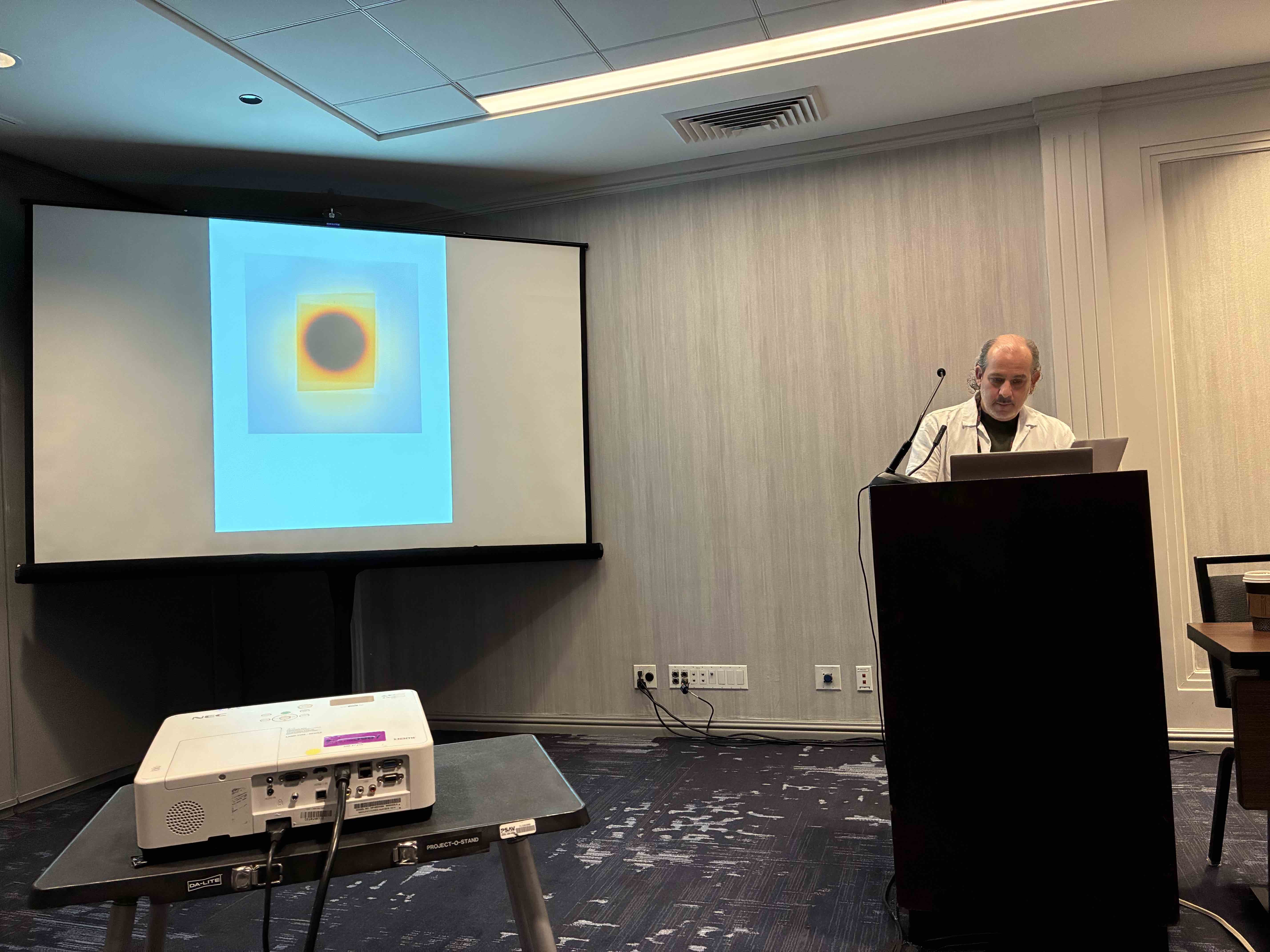
    Can you take a photograph of a black hole? What does it mean to have imaged an object whose nature is to remain unseen? Black holes are cosmic objects so small and dense that nothing, not even light, can escape their gravitational pull.  Until recently, no one had ever seen what a black hole actually looked like.  Einstein’s theories predict that a distant observer should see a ring of light encircling the black hole, which forms when radiation emitted by infalling hot gas is lensed by the extreme gravity near the event horizon.  The Event Horizon Telescope (EHT) is a global array of radio dishes, linked together by a network of atomic clocks to form an Earth-sized virtual telescope that can resolve the nearest supermassive black holes where this ring feature may be measured. The EHT has now successfully imaged the 6.5 billion solar mass black hole at the center of galaxy M87, and the 4 million solar mass black hole at the center of the Milky Way – both objects exhibiting the predicted strong gravitational lensing that confirms the theory of General Relativity at the boundary of a black hole.  This talk will cover how this was accomplished, details of the first results, and future directions. Following the talk, Doeleman will be in conversation with seminar leader Jennifer L. Roberts about how astrophysicists and humanities scholars share approaches to the unknown and unknowable.

    About the speaker

    Sheperd S. Doeleman is an Astrophysicist at the Center for Astrophysics | Harvard & Smithsonian and Founding Director of the Event Horizon Telescope (EHT), a synchronized global array of radio observatories designed to examine the nature of black holes. He is also a Harvard Senior Research Fellow and a Project Co-Leader of Harvard’s recently established Black Hole Initiative (BHI). The BHI is a first-of-its-kind interdisciplinary program at the University that brings together the disciplines of Astronomy, Physics, Mathematics, Philosophy, and History of Science to define and establish black hole science as a new field of study.

  • Launching from Print

    Launching from Print

    Jennifer L. Roberts

    Association of Print Scholars 10th Annual DIstinguished Scholar Lecture
    X.D. and Nancy Yang Professor of Arts and Sciences
    Drew Gilpin Faust Professor of the Humanities

    Harvard University
    November 14th, 2025

  • Mediating the Moon

    Mediating the Moon

    Imaging as Observation and Simulation

    Location: Université Paris 1 Panthéon-Sorbonne
    Speaker: Brooke Belisle, Associate Professor, Stony Brook University, Department of Art Institute for Advanced Computational Science

    Black holes are probably the most fascinating objects in nature. Their study places us at the frontier between known and unknown physical laws—at the intersection of classical General Relativity, quantum physics, and the still-developing theory of quantum gravity.

    https://www.youtube.com/watch?v=wVdrJqARzf8

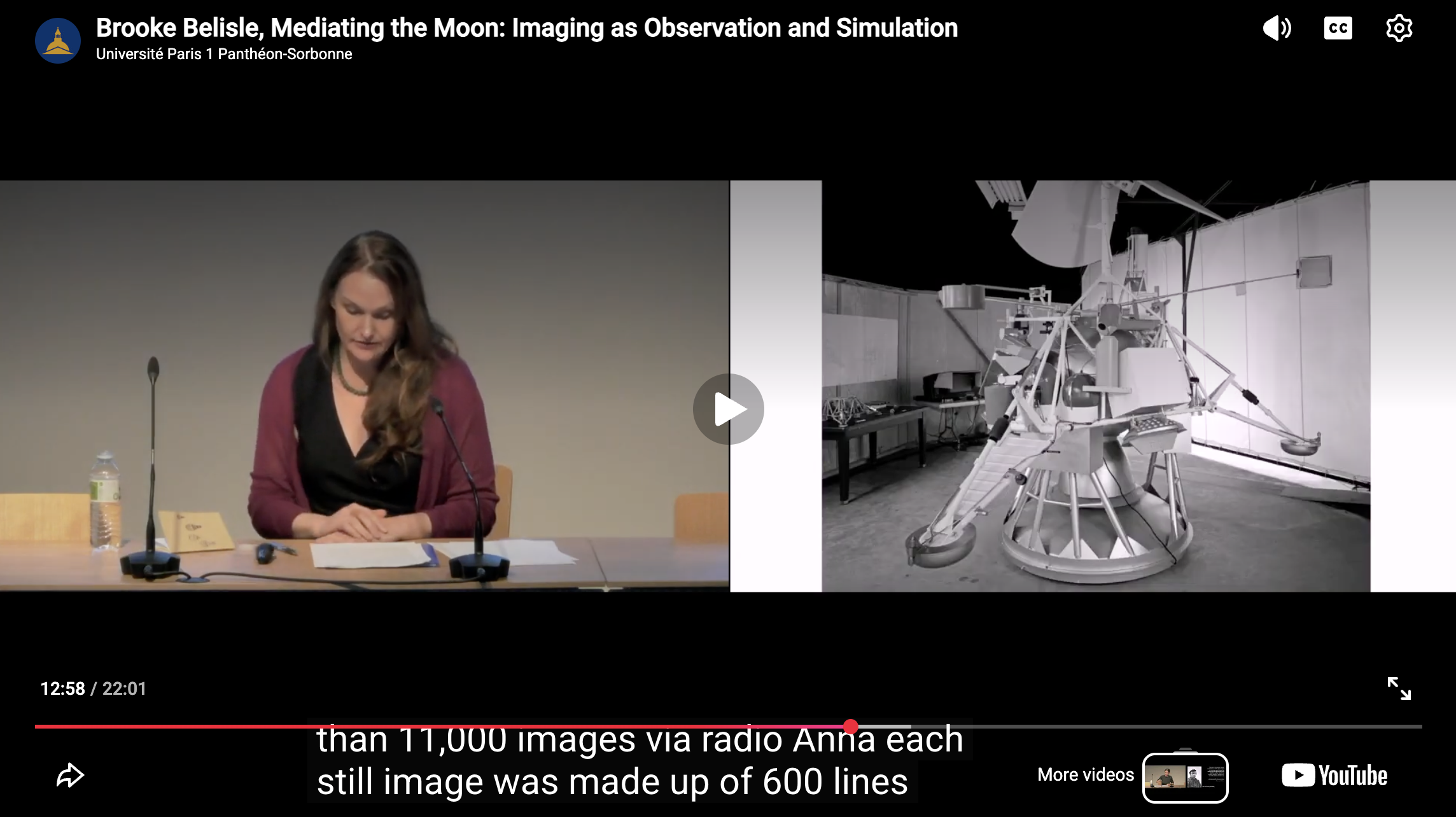
    Brooke Belisle, Mediating the Moon: Imaging as Observation and Simulation
    Brooke Belisle, Mediating the Moon: Imaging as Observation and Simulation
  • The Image Tactics of Black Holes: Moving Photographs Beyond Data 

    The Image Tactics of Black Holes: Moving Photographs Beyond Data 

    CAA Conference Presentation

    Date: February 18–21, 2026

    Location: CAA 114th Annual Conference, Hilton Chicago

    Chair: Jennifer Marine
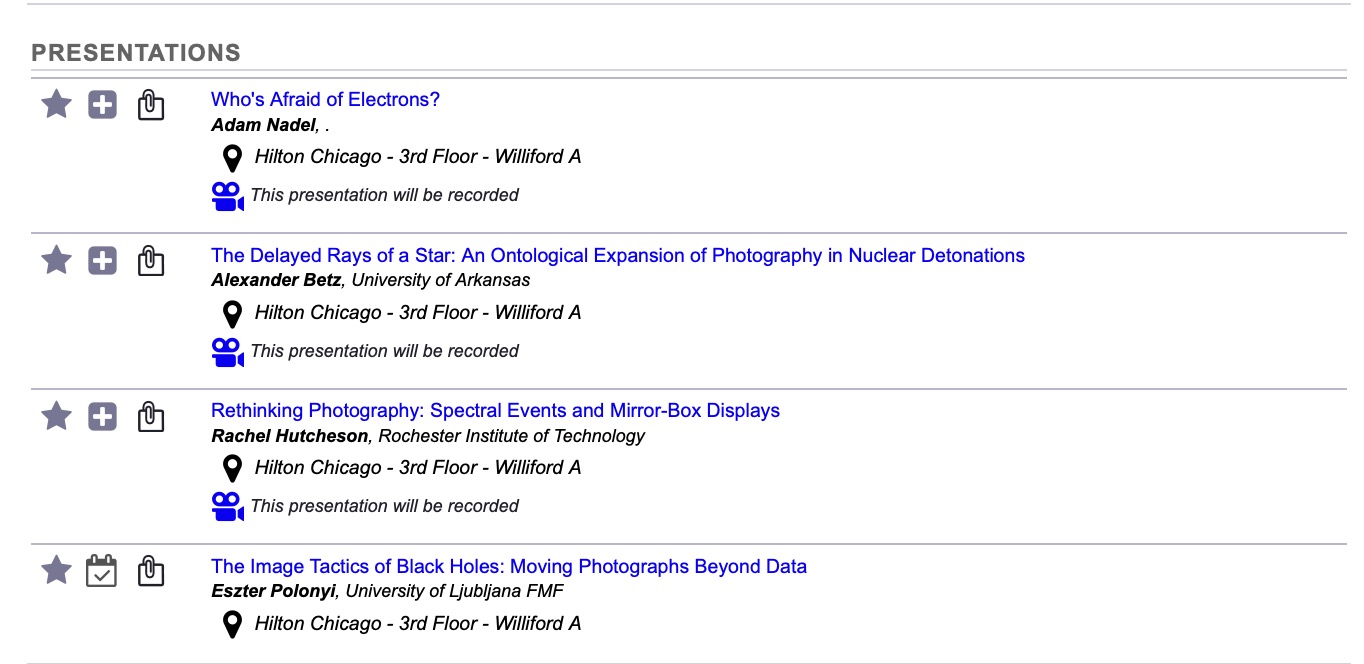
    Adam Nadel: Who’s Afraid of Electrons? 
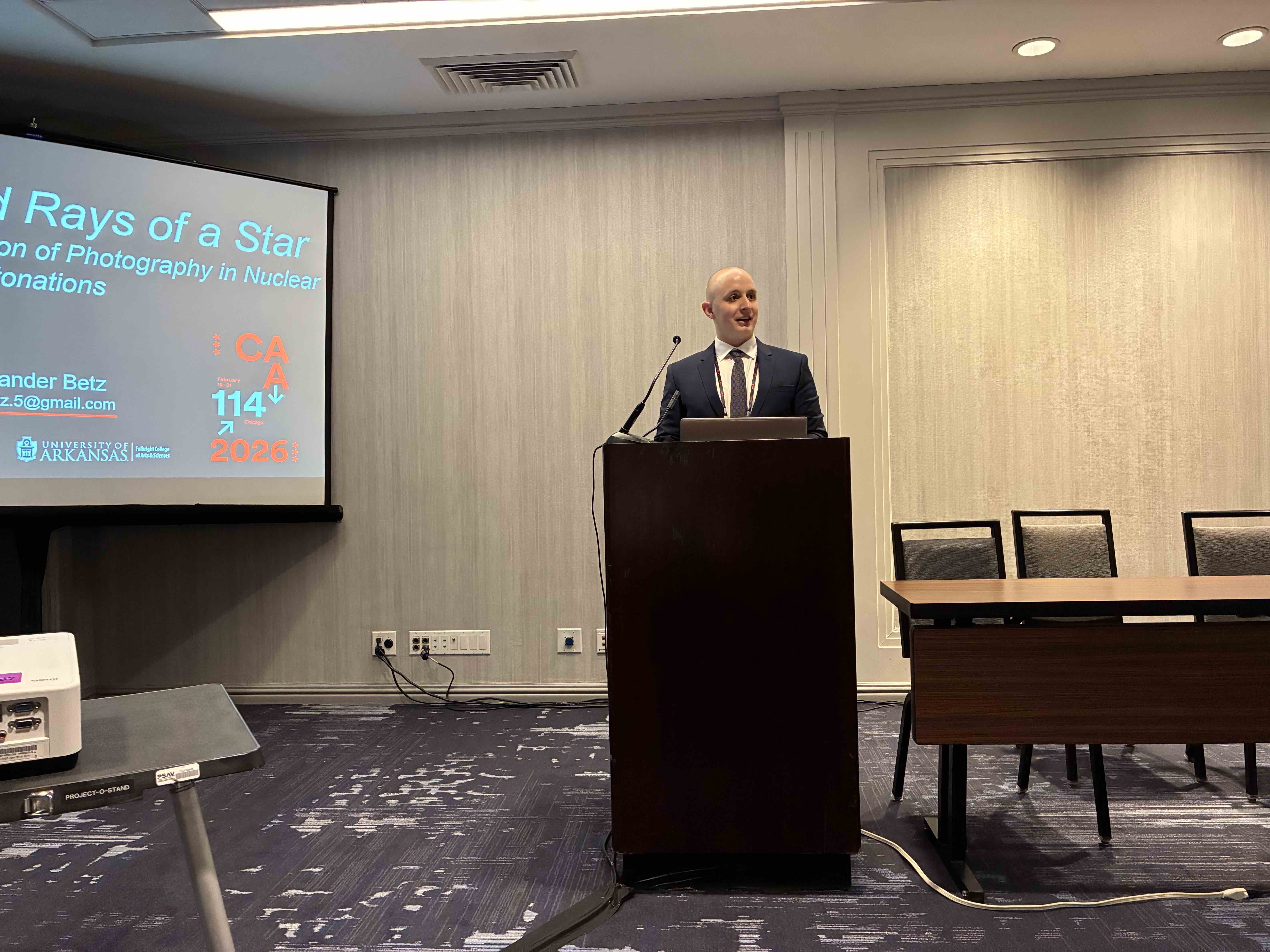
    Alexander Betz, University of Arkansas: The Delayed Rays of a Star: An Ontological Expansion of Photography in Nuclear Detonations
    Rachel Hutcheson, Rochester Institute of Technology: Rethinking Photography: Spectral Events and Mirror-Box Displays
    Eszter Polonyi, University of Ljubljana; University of the Arts Linz: The Image Tactics of Black Holes: Moving Photographs Beyond Data

    Recordings available at: https://caa.confex.com/caa/2026/meetingapp.cgi/Session/16575

    In 2019 newspapers excitedly reported that astronomers had finally “photographed” the black hole M87*. This famous image does not fit our usual definitions of photography as it used complex computer algorithms to fashion an image from collected data. Why and how is this image described as a “photograph?” This panel looks to examine objects that are named, described, titled, situated, or conventionally understood as “photographs” despite not using a camera, not recording light waves, or using other mechanical or digital methods to produce an image. Rather than being a novel phenomenon or problem, artists and scientists have struggled to define and name photography since the inception of the medium. From nineteenth-century photomechanical processes and photo-sculptures to AI image-making and astronomical visualizations, such objects are often subsumed into the category of “photography.”

    Investigating photography from this set of examples, this panel asks: What kind of objects/processes have been called a photograph? Which features and technologies are used to define the medium? How can they reimagine the medium’s history and future? Contributions might explore the reception of objects as “photographs,” the aestheticization or mediation of alternative “photographic” methods, the use of photographic processes in science, or the circulation and transmission of photographs through other media. This panel seeks to bring together papers across geographies and time periods and encourages presentations that engage with interdisciplinary perspectives including scholars working on the definitions, devices, and debates surrounding photographic methods from the nineteenth century to the contemporary.

    Abstract: By most counts, the image published by the Event Horizon Telescope of a black hole is not a photograph. Part of what has made black holes undiscoverable, beyond their being at twenty-six thousand light years from Earth is that they are understood to swallow rather than emanate light, with patterns in light’s absence making them discoverable. What makes the black hole photograph an image at all might be an equally pressing question, given that the volume of data transmission their observation requires, currently assessed at sixty-four gigabits per second at speeds that exceed earlier interferometric systems ninety-thousand-fold. The black hole photo is not just of a theoretically hyperbolic object, it also is a supermassive entity itself—of data. Drawing on the so-called Beckenstein entropy bound on information, according to which the maximum amount of data that can be put in a volume is framed in terms of a black hole, this paper considers black holes as expanding the imaginary of data to off-world frontiers in response to a crisis in both the perceived sustainability of data and its intelligibility to human perception. It looks at work by artists seeking to subvert data-saturated systems by targeting their inner propensities toward forgetting, rot, and decay, such as Hito Steyerl’s notion of impoverished images, Linda Dounia Rebeiz’s synthesis of non-existent memories, and Mimi Ọnụọha’s filling of “blank [sic] holes” with missing data. Black holes are thus presented as both hyperbolic and tactical in image theory.

  • Black Hole | Black Box: Limits, Opacity, and the Unknown Across Art, Science, and Media

    Black Hole | Black Box: Limits, Opacity, and the Unknown Across Art, Science, and Media

    Date: March 19-20, 2026

    Location: Bibliotheca Hertziana, Max Planck Institute for Art History
    Villino Stroganoff, Via Gregoriana 22, 00187 Rome (Public event without registration)

    Speaker: Dr. Eszter Polonyi

    This conference examines limits, opacity, and the unknown by bringing together two notions from very different domains: the black hole of astrophysics and the black box of computation in which theoretical and empirical boundaries are reached.

    This conference examines limits, opacity, and the unknown by bringing together two notions from very different domains: the black hole of astrophysics, where empirical and theoretical boundaries are reached, and the black box of computation and technology, whose inner workings are inaccessible even as they produce observable effects. Rather than treating them simply as objects of absence, the conference approaches black holes and black boxes as conceptual, aesthetic, and methodological frameworks for exploring what is partly unseeable, partly generative, and always challenging the thresholds of knowledge and perception. By juxtaposing perspectives from art, media, and science, we want to investigate how these frameworks allow us to study, imagine, and engage with phenomena that elude us.

    Hybrid access:
    19.02.2026:https://eu02web.zoom-x.de/j/67093757575?pwd=3V5a6hwb6NYAArZzYQ6Fq50ZyZHVKt.1
    20.03.2026:https://eu02web.zoom-x.de/j/67042030958?pwd=jRXF7TnOfuQPeSQnPX3UeoOCeRO7iQ.1