Image Making as Knowledge Production: Earth, Heavens, and Body

Category: Related Events

  • Image Making as Knowledge Production: Earth, Heavens, and Body

    Image Making as Knowledge Production: Earth, Heavens, and Body

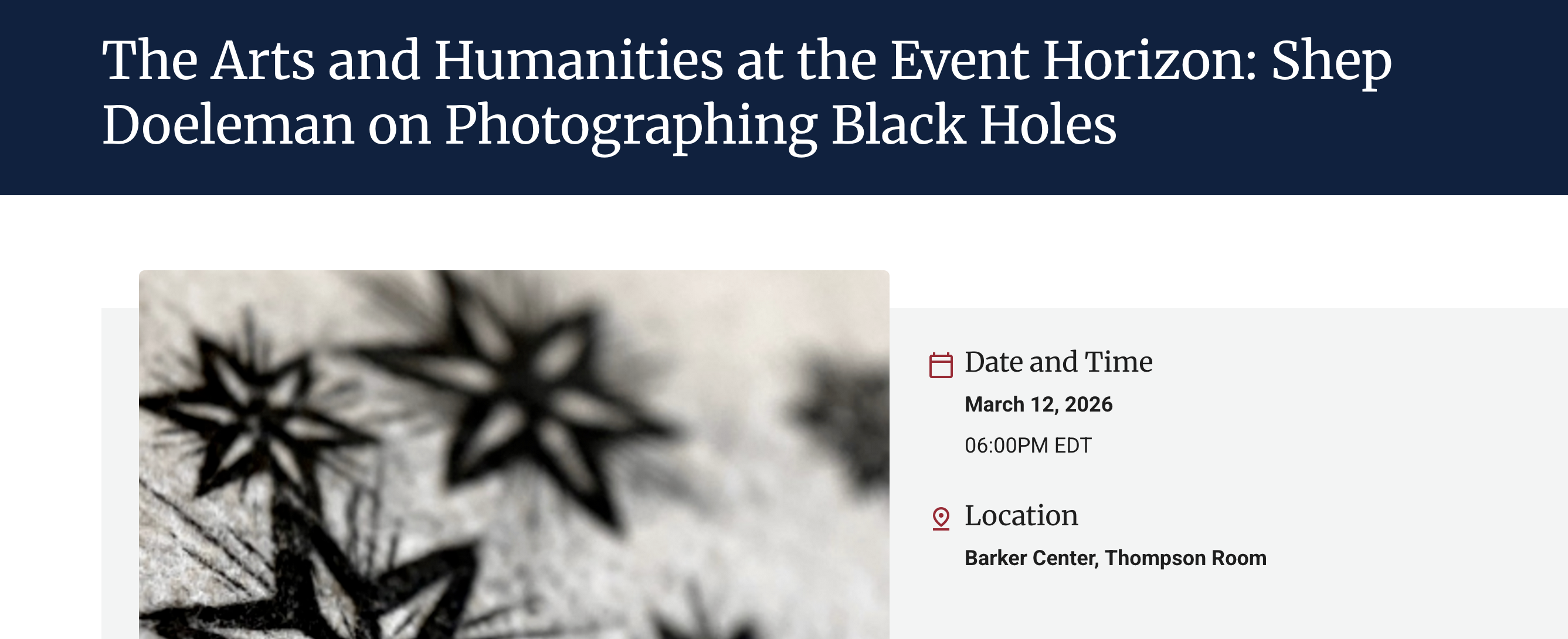
    Shep Doeleman on Photographing Black Holes

    CELESTIAL SPHERES

    Date: March 12, 2026 Time: 06:00PM EDT

    Location: Barker Center, Thompson Room

    How does the act of drawing, engraving, painting, or photographing play a role in thinking and understanding? What is the role of image-making in knowledge production? Across three themes (Earth, Heavens, and Body) we will discuss these questions in case studies from the late Middle Ages to the contemporary.Each day will start with a presentation by image-makers, to reflect on current visual practices of the context of teaching and learning, and research. The main part of the day will contain historical case studies. And each day will be closed by natural scientists reflecting on the role of image-making as doing science.
    This interdisciplinary dialogue between current-day practices and the study of historical practices in art and science have been a driving force behind the research of the Research Group Visualizing Science in Media Revolutions. With its broad temporal and thematic scope, the focus on image-making practices as both a highly skilled and highly creative process has become central to understanding how people gained and communicated knowledge.

    Please follow the event also online through our VIMEO CHANNEL:
    25.06.26 https://vimeo.com/event/590949426.06.26 https://vimeo.com/event/590950027.06.26 https://vimeo.com/event/5909503

    Day 2, 26 June: Heavens

    9:00-9:30 Guided tour of the accompanying exhibition in the Sala del disegno, Bibliotheca Hertziana (for participants only) 
    9:30–10:30 Image-maker presentation with discussion

    Chair: Sietske Fransen
    Silvia Spezzano (Max Planck Institute for Extraterrestrial Physics, Garching bei München), Imaging Molecules in Interstellar Space

    Coffee break

    11:00–13:00 Session 4
    Chair: Eelco Nagelsmit (Vrije Universiteit Amsterdam / BHMPI)1. Stefan Zieme (CNRS – Observatoire de Paris / PSL), The Diagrams of the First Appendix of Naṣīr al-Dīn al-Ṭūsī’s (1201-74) Taḥrīr al-Majisṭī 
    2. Eric Jorink (Huygens / KNAW, Amsterdam), Christiaan Huygens and the Mystery of Saturn’s Ring: Observation, Visual Thinking, and Peer Review
    3. Antoine Gallay (Université de Lausanne), Making the Incommensurable Tangible: Visualizing the Solar System in Christiaan Huygens’s Cosmotheoros (1698)

    Lunch break

    14:00–15:30 Session 5 
    Chair: Lena Heinlein-Müller (Goethe Universität, Frankfurt am Main)
    4. Odile Lehnen (Durham University / The Royal Society), A Seat at the Table: Collaborative Observation in the Herschel Household
    5. Marvin Bolt (Independent Scholar, USA), In Defense of the Inhabited Sun: Visualizing William Herschel’s Strange Idea

    Coffee break

    16:00–17:30 Session 6
    Chair: Sietske Fransen
    6. Nina Caviezel (BHMPI / Universität Basel), From Dust to Data: Cleaning as a Visualizing Practice in Astronomy  7. Charlotte Bigg (CNRS, Centre Alexandre Koyré, Paris), Blurry Skies

    17:30–18:00 Guided tour of the accompanying exhibition in the Sala del disegno, Bibliotheca Hertziana (for participants only) 

    18:00–19:00 Dinner in Villino (for participants only)

    19:00–20:30 Scientist presentation with discussion
    Chair: Tanja Michalsky (BHMPI)

    Peter Galison (Harvard University, Cambridge, MA), Image Knowledge: Filming Black Holes
  • The Arts and Humanities at the Event Horizon

    The Arts and Humanities at the Event Horizon

    Shep Doeleman on Photographing Black Holes

    CELESTIAL SPHERES

    Date: March 12, 2026 Time: 06:00PM EDT

    Location: Barker Center, Thompson Room

    Speaker: Shep Doeleman, Harvard University / Smithsonian Astrophysical Observatory

    Can you take a photograph of a black hole? What does it mean to have imaged an object whose nature is to remain unseen? Black holes are cosmic objects so small and dense that nothing, not even light, can escape their gravitational pull.  Until recently, no one had ever seen what a black hole actually looked like.  Einstein’s theories predict that a distant observer should see a ring of light encircling the black hole, which forms when radiation emitted by infalling hot gas is lensed by the extreme gravity near the event horizon.  The Event Horizon Telescope (EHT) is a global array of radio dishes, linked together by a network of atomic clocks to form an Earth-sized virtual telescope that can resolve the nearest supermassive black holes where this ring feature may be measured. The EHT has now successfully imaged the 6.5 billion solar mass black hole at the center of galaxy M87, and the 4 million solar mass black hole at the center of the Milky Way – both objects exhibiting the predicted strong gravitational lensing that confirms the theory of General Relativity at the boundary of a black hole.  This talk will cover how this was accomplished, details of the first results, and future directions. Following the talk, Doeleman will be in conversation with seminar leader Jennifer L. Roberts about how astrophysicists and humanities scholars share approaches to the unknown and unknowable.

    About the speaker

    Sheperd S. Doeleman is an Astrophysicist at the Center for Astrophysics | Harvard & Smithsonian and Founding Director of the Event Horizon Telescope (EHT), a synchronized global array of radio observatories designed to examine the nature of black holes. He is also a Harvard Senior Research Fellow and a Project Co-Leader of Harvard’s recently established Black Hole Initiative (BHI). The BHI is a first-of-its-kind interdisciplinary program at the University that brings together the disciplines of Astronomy, Physics, Mathematics, Philosophy, and History of Science to define and establish black hole science as a new field of study.

  • Launching from Print

    Launching from Print

    Jennifer L. Roberts

    Association of Print Scholars 10th Annual DIstinguished Scholar Lecture
    X.D. and Nancy Yang Professor of Arts and Sciences
    Drew Gilpin Faust Professor of the Humanities

    Harvard University
    November 14th, 2025

  • Mediating the Moon

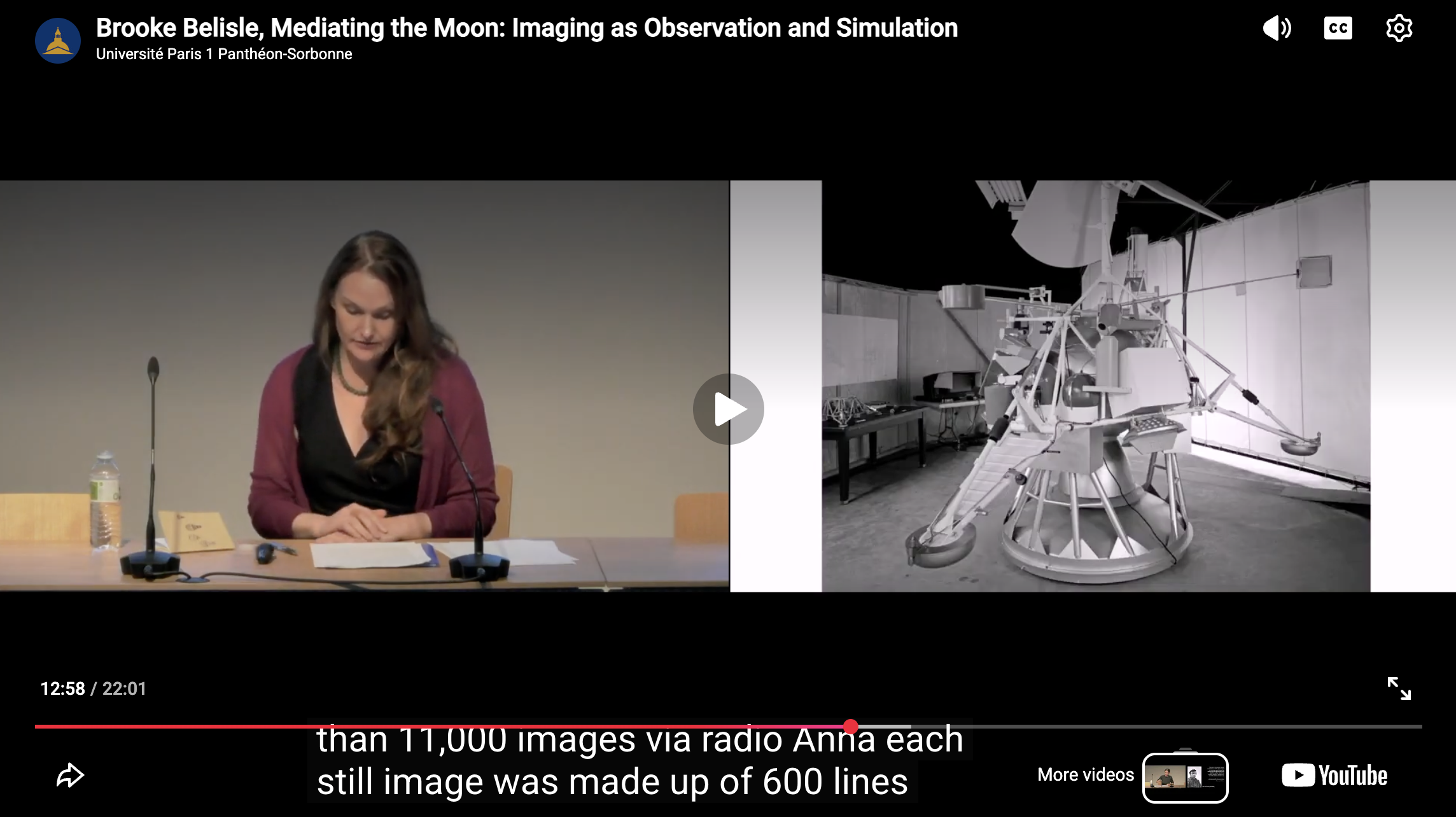
    Mediating the Moon

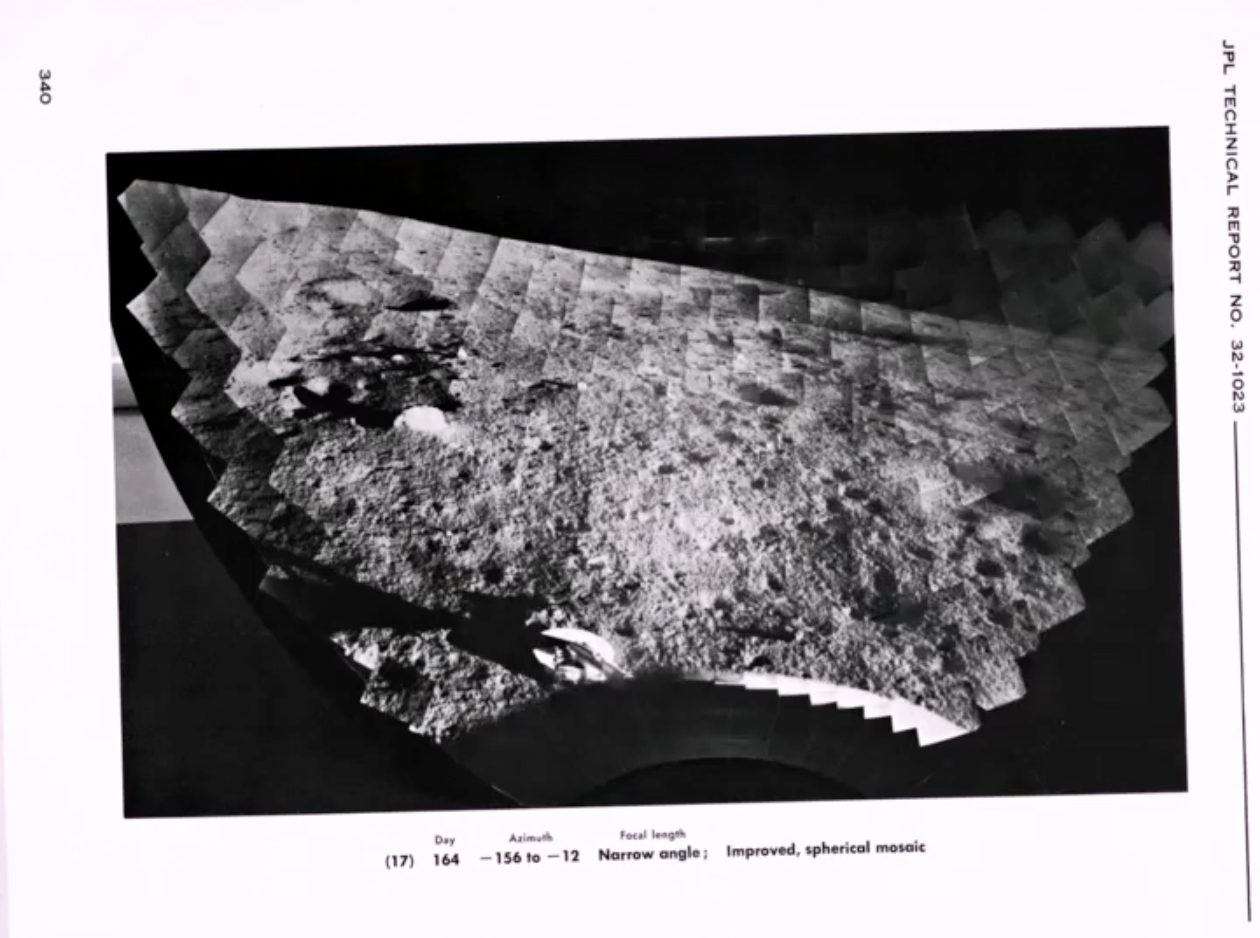
    Imaging as Observation and Simulation

    Location: Université Paris 1 Panthéon-Sorbonne
    Speaker: Brooke Belisle, Associate Professor, Stony Brook University, Department of Art Institute for Advanced Computational Science

    Black holes are probably the most fascinating objects in nature. Their study places us at the frontier between known and unknown physical laws—at the intersection of classical General Relativity, quantum physics, and the still-developing theory of quantum gravity.

    https://www.youtube.com/watch?v=wVdrJqARzf8

    Brooke Belisle, Mediating the Moon: Imaging as Observation and Simulation
    Brooke Belisle, Mediating the Moon: Imaging as Observation and Simulation
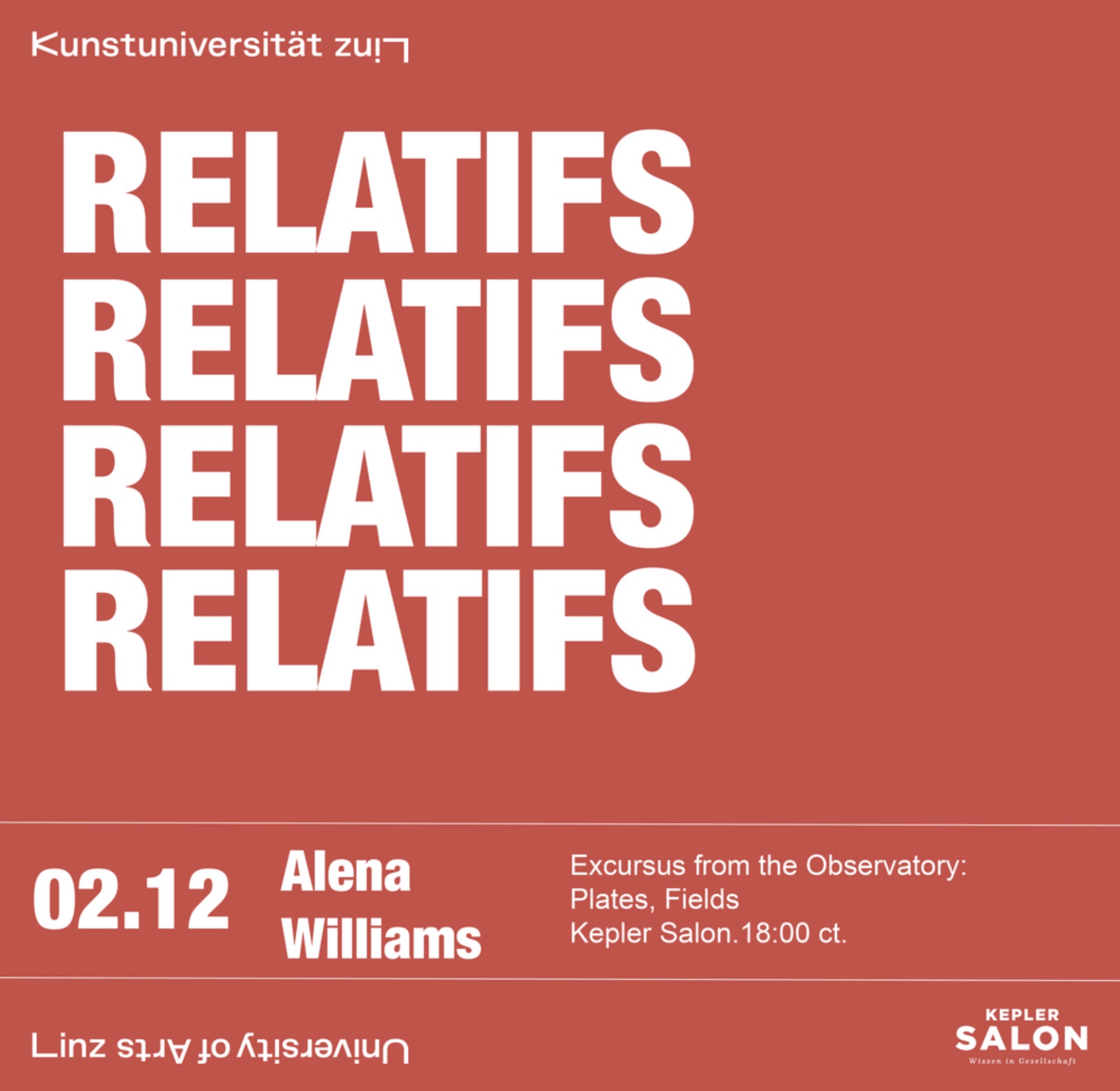
  • Excursus from the Observatory

    Excursus from the Observatory

    Kunstuniversitaet Linz

    Date: 2. Dezember 2025, Time: 18.00 Uhr
    Location: Avditorij Narodne galerije, Ljubljana 1000
    Organized by the Relatifs Lecture Series of Kunstuniversitaet Linz.

    Plates, Fields, a lecture by Alena J. Williams, Professor for Theory and Mediation of Contemporary Art in the Department for Art Theory and Cultural Studies at the Academy of Fine Arts in Vienna. https://www.kunstuni-linz.at/en/university/organisational-structure-1/institutes/fine-arts-and-cultural-studies/news/news/excursus-from-the-observatory-plates-fields


    Antifaschismus | Kunst und (Neue) Rechte
25. März 2026
    Antifaschismus | Kunst und (Neue) Rechte
    25. März 2026
    Antifaschismus | Kunst und (Neue) Rechte 25. März 2026
    Antifaschismus | Kunst und (Neue) Rechte 25. März 2026