
2025
Title: Black Holes and «One Hundred Thousand Suns»
Seminar and workshop
Location: Bibliotheca Hertziana, Max Planck Institute for Art History, Rome
Date: Nov. 27, 2025, Villino Stroganoff, Via Gregoriana 22, 00187 Rome and online
Speakers: Dr. Eszter Polonyi, Dr. Sašo Grozdanov, and Rohini Devasher
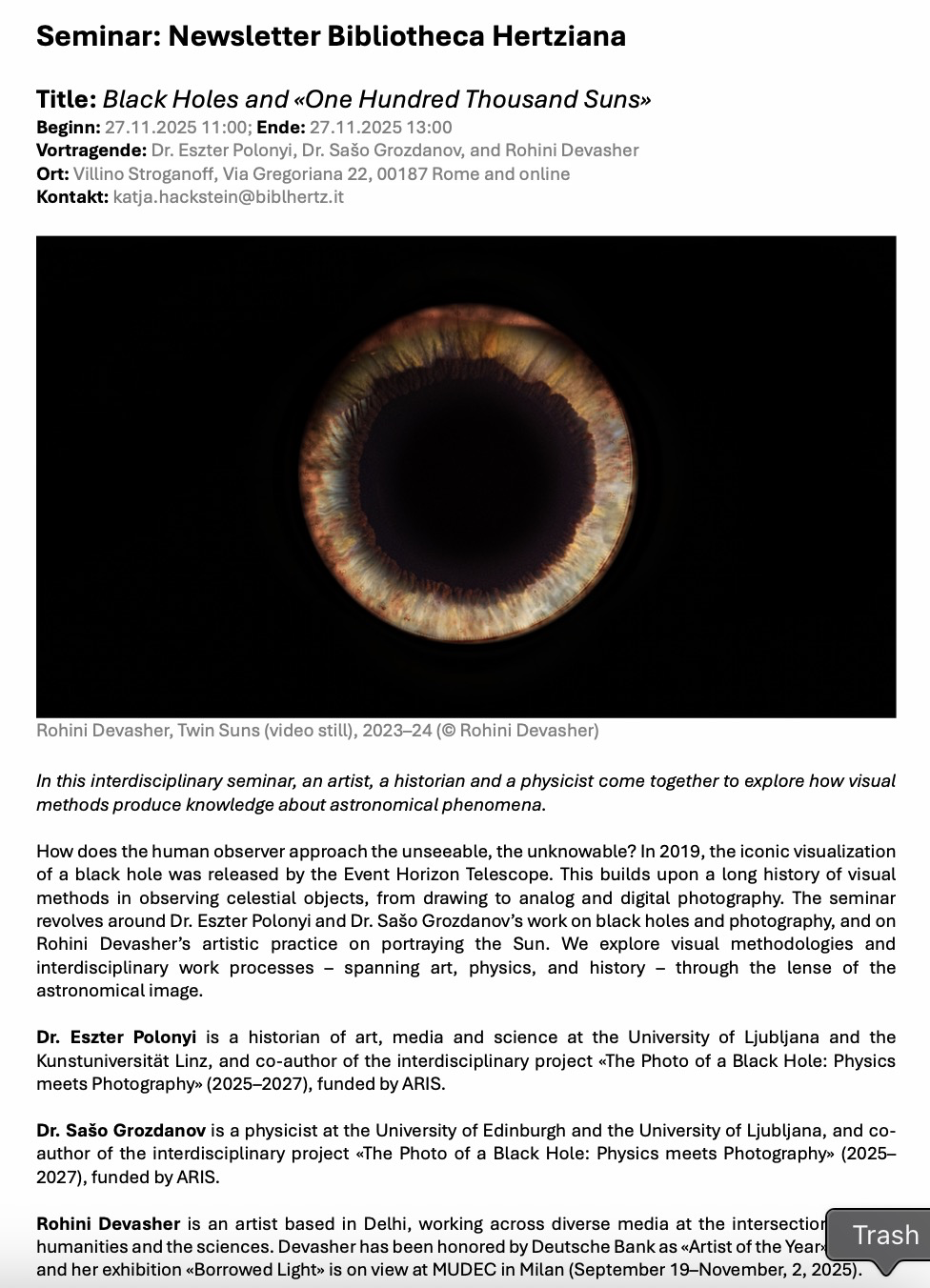
In this interdisciplinary seminar, an artist, a historian and a physicist come together to explore how visual methods produce knowledge about astronomical phenomena. How does the human observer approach the unseeable, the unknowable? In 2019, the iconic visualization of a black hole was released by the Event Horizon Telescope. This builds upon a long history of visual methods in observing celestial objects, from drawing to analog and digital photography. The seminar revolves around Dr. Eszter Polonyi and Dr. Sašo Grozdanov’s work on black holes and photography, and on Rohini Devasher’s artistic practice on portraying the Sun. We explore visual methodologies and interdisciplinary work processes – spanning art, physics, and history – through the lense of the astronomical image.

2026
Title: The Image Tactics of Black Holes: Moving Photographs Beyond Data
Conference Presentation
Location: at College Art Association, New York, February 2026
Panel Title: (Methodological) Black Holes in Photography
Absract: By most counts, the image published by the Event Horizon Telescope of a black hole is not a photograph. Part of what has made black holes undiscoverable, beyond their being at twenty-six thousand light years from Earth is that they are understood to swallow rather than emanate light, with patterns in light’s absence making them discoverable. What makes the black hole photograph an image at all might be an equally pressing question, given that the volume of data transmission their observation requires, currently assessed at sixty-four gigabits per second at speeds that exceed earlier interferometric systems ninety-thousand-fold. The black hole photo is not just of a theoretically hyperbolic object, it also is a supermassive entity itself—of data. Drawing on the so-called Beckenstein entropy bound on information, according to which the maximum amount of data that can be put in a volume is framed in terms of a black hole, this paper considers black holes as expanding the imaginary of data to off-world frontiers in response to a crisis in both the perceived sustainability of data and its intelligibility to human perception. It looks at work by artists seeking to subvert data-saturated systems by targeting their inner propensities toward forgetting, rot, and decay, such as Hito Steyerl’s notion of impoverished images, Linda Dounia Rebeiz’s synthesis of non-existent memories, and Mimi Ọnụọha’s filling of “blank [sic] holes” with missing data. Black holes are thus presented as both hyperbolic and tactical in image theory.

