
by Lea Sande, 19.07.2026
When labeling something a black box, we are generally conceptualising it as an enclosed system or process that receives clear inputs and generates intelligible outputs, but its inner workings remain unexplainable or unobservable.1 Although the concept emerged from cybernetics and engineering, it can be applied equally to technological, biological, social, and ecological systems. In our daily life, we are constantly dependent on black boxes of different scales. We don’t need to have insight into the logistics of the entire rail network in order to get to work, nor do we need to understand the technical architecture of a kitchen blender to prepare a meal. Based on our understanding, most systems are at least partially black boxed.
Alexander R. Galloway2 distinguishes between two types of black boxes; the black box as a “cypher” that needs to be decoded, its inner workings revealed by taking off one of the sides and observing its mechanics, and the black box as a “function”, a system that grants just enough opacity to be usable, but never reveals its true structure. He transforms Marx’s famous quote from “rational kernel inside a mystical shell” into “rational shell and the mystical kernel” which shows a qualitative break in our understanding and use of black boxes. If the capitalist market operated as a black box through the intertwined mechanisms of exploitation, appropriation of surplus value, alienation and ideology, once we see through these systems we should be able to demystify the black box, claim our class consciousness and break free. Platform capitalism works through interfaces, abstractions and relays, a system so highly composite that it affords users different levels of transparency based on their nationality, race, gender, profession and social mobility, with the position of the user becoming more and more crucial. The economic system itself is an increasingly complexifying black box, supported by an enormous amount of other auxiliary black boxes that keep it running.
Not all black boxes need to be dismantled. In fact, our daily life arguably benefits from not seeing the world as a combination of materials and components. Abstraction and modeling let us use the computer without always keeping track of what the processor is currently calculating or how the drivers are interacting, but lets us focus on the emails we need to type. Even human interactions are, to some extent, black boxes that we can only navigate by a computationally very intense combination of reading facial expressions, gestures, social cues and language tokens. This line of thinking resonates with Blaise Agüera y Arcas’s definition of intelligence as the ongoing modeling of other selves, though we invoke it here less as a definitive account of cognition than as a useful way of conceptualizing how opacity and inference structure social interaction.3
Nevertheless, black boxes often represent the limits of scientific reach and perception, two of the most prominent in recent years being black holes and machine learning, as they both challenge the normative assumptions and understanding of fundamental physics,4 computation and language theories.5 Some of the most prominent advances and breaks in research have come exactly out of probing these black boxes, examining their edge cases and studying the ways they refract or break our current knowledge systems.
One of the most difficult forms of opacity emerges not from secrecy, but from incommensurability: situations in which different systems of knowledge can no longer be fully translated into one another. In the case of contemporary computational systems, this occurs when the scale, abstraction, or operational logic of a system exceeds the conceptual frameworks available for interpreting it. Based on Bruno Latour’s6 reflections, Beatrice Fazi7 argues that even science itself is a black box in the way it operates, as “[s]cience, for Latour, can become a black box when its inner workings are no longer open for scrutiny or debate, when consensus has been reached about certain results, when the success of a theory or a method obscures how scientific and technical work operates, and when a hypothesis is settled as a matter of fact. So, paradoxically, ‘the more science and technology succeed, the more opaque and obscure they become’”.8
Furthermore, in regards to the Jenna Burrell proposes a typology,9 of three kinds of black boxes: opacity as intentional corporate or state secrecy that generates a black box by the obfuscation of knowledge about a system from a third party, opacity as technical illiteracy that creates a black box due to the lack of understanding as a personal circumstance, and opacity as the way algorithms operate at the scale of application. This last, we can translate to: opacity that stems from the fundamental mismatch of knowledge systems. The most complex and difficult to breach, opacity as epistemic mismatch materialises, for instance, in machine learning research as a rudimentary conflict between our own and the computational understanding of abstraction – an inability of two systems of knowing the world to coexist or be integrated with each other.
Because the position of the observer, both in black boxes and black holes, is key, the only way to meaningfully study them and try to move past the problem of incommensurability is to try to analyse them from many different viewpoints10. Just as the Event horizon Telescope Collaboration11 combined an unimaginable amount of data from different perspectives to generate an image, scientific progress in studying black holes is most productive when taking a similar approach.
What is most interesting is that, in the case of black holes, black boxing appears to loop back on itself, as it brings into relation theoretical frameworks that were previously in tension – like quantum gravity and conformal field theory – through constructs such as the correspondence between conformal field theories and Anti-de Sitter spaces. These theories do not fully reconcile, but are made to coexist within a shared formal structure. In this sense, black holes break scientific perception and bend the boundaries between incommensurable paradigms, forcing them into relation in our attempts to understand these complex phenomena.
Black holes should thus be studied as black boxes, because they both limit transparency and reflect the frameworks through which we try to conceptualise them while also reorganising the conditions of explanation, forcing incompatible theories into uneasy but productive relations. A black hole and its event horizon is a site where knowledge bends, multiplies, and becomes probabilistic. As Iris Long writes, “we should catch sight of […] the black box as an unformed spacetime, a field of proto-probabilities […].”12 Therefore, black holes might just represent the most compelling and complex black boxes of all.
- Galloway, A. R. (2010). Black box, black bloc (Lecture delivered at the New School, New York City, April 12, 2010), Fazi, M. B. (2021). Beyond human: Deep learning, explainability and representation. Theory, Culture & Society, 38(7–8), 55–77. https://doi.org/10.1177/0263276420966386, Latour, B. (1987). Science in action: How to follow scientists and engineers through society. Harvard University Press & Ashby, W. R. (1956). An introduction to cybernetics. Chapman & Hall, 68-93. ↩ ↩︎
- Galloway, A. R. (2010). Black box, black bloc (Lecture delivered at the New School, New York City, April 12, 2010) ↩︎
- Aguera y Arcas, B. (2025). What is intelligence? Noēma Magazine. https://www.noemamag.com/what-is-intelligence/ ↩︎
- Barack, L., Cardoso, V., Nissanke, S., Sotiriou, T. P., Askar, A., Belczynski, K., Bertone, G., Bon, E., Blas, D., Brito, R., Bulik, T., Burrage, C., Byrnes, C. T., Caprini, C., Chernyakova, M., Chruściel, P., Colpi, M., Ferrari, V., Gaggero, D., Gair, J., et al. (2019). Black holes, gravitational waves and fundamental physics: A roadmap. arXiv. https://doi.org/10.48550/arXiv.1806.05195 ↩︎
- Beguš, G., Dąbkowski, M., & Rhodes, R. (2023). Large linguistic models: Investigating LLMs’ metalinguistic abilities. arXiv. https://arxiv.org/abs/2305.00948 ↩︎
- Latour, B. (1987). Science in action: How to follow scientists and engineers through society. Harvard University Press. ↩︎
- Fazi, M. B. (2021). Beyond human: Deep learning, explainability and representation. Theory, Culture & Society, 38(7–8), 55–77. https://doi.org/10.1177/0263276420966386 ↩︎
- Ibid.: 60 ↩︎
- Burrell, J. (2016). How the machine ‘thinks’: Understanding opacity in machine learning algorithms. Big Data & Society, 3(1), 1–12. https://doi.org/10.1177/2053951715622512 ↩︎
- Polonyi, E., & Grozdanov, S. (2025). When observation becomes entanglement: Physics, photography, and data [Conference session]. The Sun’s Glow, the Black Hole’s Shade: Where Observation Begins & Ends, Bibliotheca Hertziana – Max Planck Institute for Art History, Rome, Italy and online. https://www.biblhertz.it/events/43555/2643800 ↩︎
- https://eventhorizontelescope.org/ ↩︎
- Long, I. (2025). The moon’s reflection on the water and the flower’s reflection in a mirror. In B. Bratton, A. Greenspan, A. Ireland, & B. Konior (Eds.), Machine decision is not final: China and the history and future of artificial intelligence pp. 224. Urbanomic. ↩︎
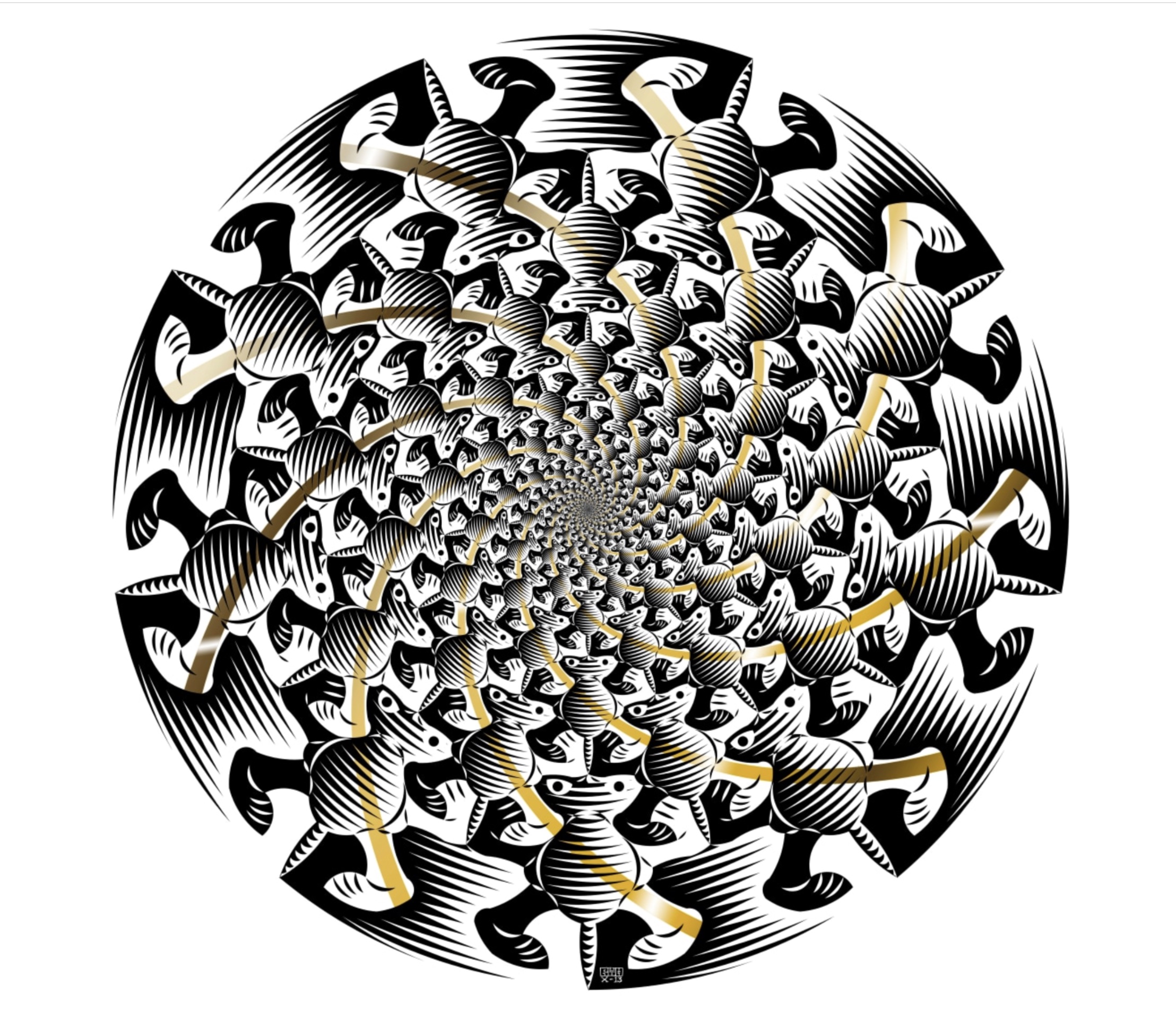
Top image: Richard Hassell. Turtles All the Way Down I, Edition of 8, 2015. Archival print with gold leaf. The author gratefully acknowledges Richard Hassell for granting permission to reproduce this work